Mark T., 34, from Tampa Bay, Florida, saw an opportunity in late 2024. He paid $480 in cryptocurrency for six cloned debit cards, complete with PINs, sourced from a darknet marketplace. The cards carried stolen magnetic stripe data from real accounts.
Three ATMs handed over $4,200 in cash. The fourth one ended the run. What happened next took fifteen days from first withdrawal to arrest, and it reveals why the physical world still holds the strongest evidence against digital crime.
This is not a manual for buying cards. It is a look at how a person thought he had disappeared and how quickly the infrastructure around him proved otherwise.
Key takeaways
- ATMs record faces, transactions, and locations; they turn a digital crime into physical evidence.
- A KYC exchange entry point can link identity to a privacy-focused cryptocurrency purchase.
- Bank anti-fraud systems often flag geographic withdrawal clusters before any human investigates.
- Physical evidence at home, such as cards and a read/write device, cannot be laundered.
- The buyer of cloned cards, not the organizer, usually faces the most immediate physical and legal risk.
How does the carding chain actually work?
Carding is the trade and use of stolen banking data.
The basics rarely change. Someone steals card data through skimmers on ATMs, shimmer devices inside readers, phishing pages, or by buying dumps from darknet markets. That data includes magnetic track information, often called track 1 and track 2. It then gets written onto blank plastic. The finished card gets an embossed number, a name, and an expiration date so it looks legitimate at a glance.
If the PIN was also compromised with an overlay keypad or a hidden camera above the keypad, the buyer receives a ready-made tool for cash withdrawal. From there, the typical flow moves to cashing out at an ATM before the victim notices and blocks the account. After that, the stolen cash often turns into cryptocurrency through a Bitcoin ATM or a peer-to-peer exchange.
What the buyer overlooks
People picture carding as mostly a digital crime. In practice, the final step happens in front of a machine that records almost everything. An ATM is not just a cash dispenser. It is a collection point for evidence, and that detail changes how these cases end.
Mark bought the cards from a marketplace that will not be named here. Payment went through Monero, chosen because it is harder to trace. The package arrived by mail in neutral wrapping. Everything looked like a clean transaction. The problem was not in the purchase. The problem was standing in front of the machine.
What made the ATM more useful than a detective?
The camera.
A modern ATM records more than a user expects. Inside almost every unit there is a built-in camera aimed at the face, often recording at 1080p with infrared for night conditions. Many machines also include a second, hidden camera at a different angle. The transaction log preserves the time, amount, card number, ATM identifier, and status for every withdrawal, down to the second. The machine knows its own location and sends that information to the bank. Network requests to the processor are also logged.
When Mark used that fourth ATM in a Tampa Bay suburb, the camera caught his face in full profile. No mask, no glasses, no hat. Twenty-three seconds of footage. That was enough to connect a digital crime to a physical person.
Often people think darknet anonymity follows them into the real world. In practice, an ATM is the point where digital theft becomes physical, and the anonymity ends there.
How did the investigation unfold in fifteen days?
It started with three victims in three states.
The first reports arrived in November 2024. Account holders in Florida, Georgia, and North Carolina noticed unauthorized withdrawals and contacted their banks. The banks blocked the affected cards and passed the information to an early fraud warning system. By day three, the bank's automated anti-fraud system had identified a pattern: withdrawals from the same group of cloned cards spread across different states within a short time. An emergency flag was raised automatically and the case moved to the bank's investigation department.
By day five, the case reached the U.S. Secret Service, which holds jurisdiction over many financial crimes. Analysts requested logs and video from all involved ATMs. By day eight, footage from the fourth ATM produced a clear face. A comparison against the Florida Department of Public Safety driver's license database returned a match: Mark T., with no prior convictions. The transaction analysis added another layer. Every withdrawal had happened within 40 miles of his home address.
The digital trail tightened
A search warrant followed for browser history, ISP records, and crypto wallet activity. The ISP data showed visits to Tor exit nodes at times that matched the purchase. A court order to the exchange where Mark bought Monero connected his verified identity to the wallet later used on the darknet marketplace. By day fourteen, a search warrant for the house led to six blank plastic cards, a magnetic stripe read/write device, a laptop with Tor Browser history, $3,200 in cash, and shipping packaging. The arrest came on day fifteen. Mark confessed to buying the cards and cashing out four of them. The remaining two had already been blocked by the bank.
This section contains the source link.
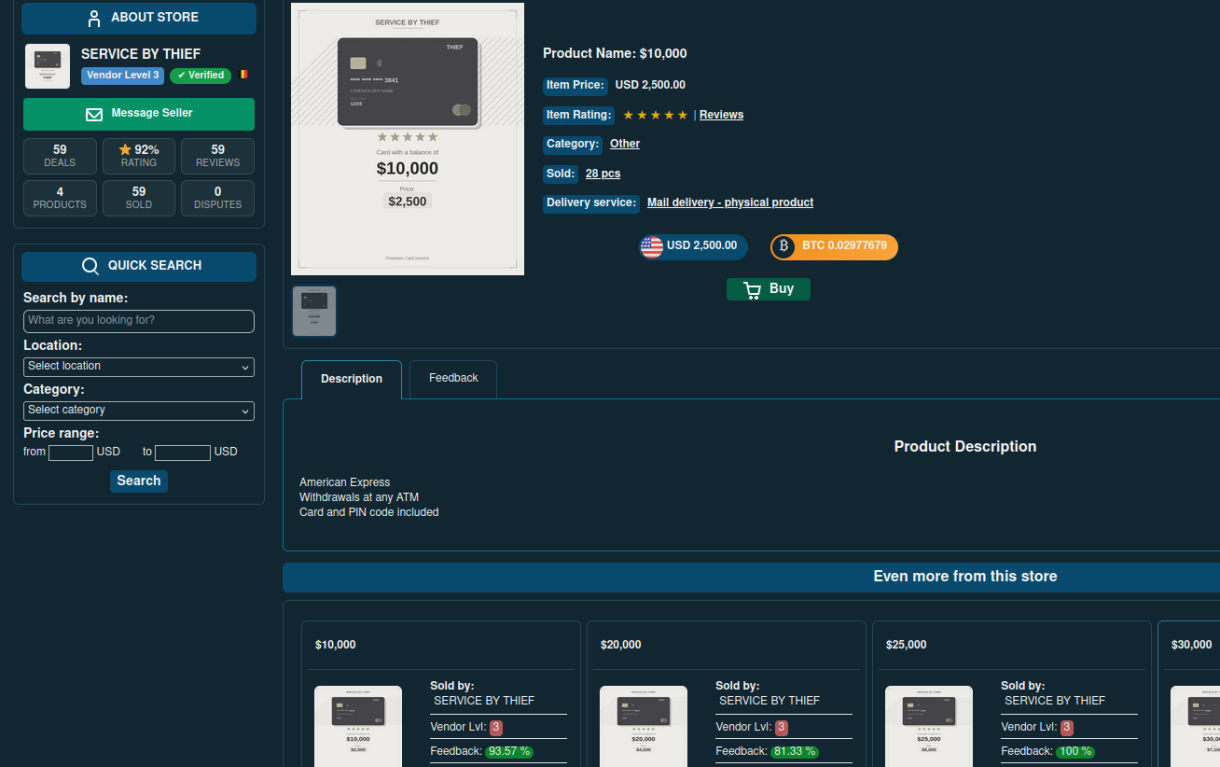
A carding marketplace product page shows pricing and seller feedback.
What did the numbers look like?
The case reduced to a short ledger.
Withdrawals: four. Amount withdrawn: $4,900. Paid for the cards: $480. Days from first withdrawal to arrest: fifteen. Federal prison sentence: 60 months. Fine and restitution: $22,000. Supervised release: three additional years.
Those figures explain the risk more clearly than any lecture. A person spent less than five hundred dollars and lost five years of freedom, plus money and a permanent record.
This section contains the source of the case and the practices for card skimming protection.
Why didn't Monero protect him?
Anonymity has edges.
He paid with a privacy-focused cryptocurrency, but the path still closed around him. The first weak point was the purchase of Monero itself. To buy the cryptocurrency, Mark used a centralized exchange with know-your-customer verification. He uploaded a passport and a selfie. A court order compelled the exchange to provide his identity and transaction history. Even though later crypto movement is hard to follow, the very act of buying Monero on the right date and in the right amount became evidence.
The second issue was the timing. Buying Monero, ordering from the marketplace, receiving the cards, and withdrawing cash all took place within two weeks. That overlap created circumstantial evidence that carried weight in court.
Physical evidence made it worse. The cards seized at his home contained magnetic tracks that matched stolen data from real victims. That is direct evidence that no cryptocurrency can clean.
Then there was the video. A face on camera cannot be moved to another wallet. Even if the rest of the chain had been perfect, the video tied him to the crime scene.
What went wrong?
Six specific mistakes stand out.
First, all four ATMs were within 40 miles of his home. Anti-fraud systems flag geographic clusters immediately. Second, he wore nothing to obscure his face. A clear image is a direct route to identification through state databases. Third, he used a centralized exchange to enter the crypto system, which linked his verified identity to the payment method. Fourth, he stored evidence at home: cards, the read/write device, and a laptop with traces of Tor Browser. Digital traces often survive deletion attempts. Fifth, cash. The seized denominations matched ATM output. Sixth, speed. All withdrawals took place over two weeks, which gave the automated systems a clear pattern.
Had he spread the withdrawals over months, the fraud system might have moved more slowly. The cameras would have been there anyway.
What does the case teach security professionals?
A few lessons.
The bank's anti-fraud system worked before any human became involved. Pattern analysis, geolocation rules, and scoring models flagged the activity automatically. Banks that continue investing in machine learning for anomaly detection are adding to their most practical defense layer.
Physical and digital evidence work together. The ATM video was physical evidence, but without the transaction log it would not point to a specific second. Combining those two worlds is the foundation of most successful financial crime investigations.
The myth of the untraceable currency
Privacy coins do not remove the entry and exit points. Buying crypto through a KYC exchange and turning it into cash at an ATM are the two ends of a chain that connects the digital and physical worlds. As long as KYC exists, full anonymity stays out of reach.
Customer education remains the overlooked layer. Victims who report theft quickly help banks block cards before more cash disappears. Banks that teach clients to notice unauthorized withdrawals reduce the total damage. The same applies to checking for credit card skimmers at the point of use: a physical inspection of a reader costs seconds and can prevent a long chain of fraud.
If a person wants to learn how to check for credit card skimmers, the habit is simple. Inspect the card reader for loose parts, misaligned colors, or unusual thickness. Cover the PIN pad while typing. Use contactless payment where possible. These actions do not eliminate fraud, but they raise the cost for the attacker.
For those who ask how to tell if there is a card skimmer, the answer often begins with a gentle pull on the reader and a look at the alignment. A credit card skimming device detector app can help in some situations, but no app replaces a visual check. How to tell if a card reader has a skimmer is usually about noticing small changes: a new overlay, a slightly darker panel, or a reader that feels loose. These are signs that something may have been added.
Card skimming protection is not a product. It is a mindset. A credit card skimming protection plan includes checking statements, setting up transaction alerts, and using bank cards with a chip rather than only a magnetic stripe. A card skimmer protector is not a gadget that eliminates risk. It is a practice. Some sellers market credit card skimmer protection devices, but the most reliable tool remains a careful look at the machine and a covered keypad.
Discussions about card skimming reddit threads often share similar advice: check the machine, cover the PIN, and report anything suspicious to the bank. The same principle applies to cloned cards reddit conversations: the people who get caught are not always the ones who made the cards. They are the ones who touched the machine.
Carding forums dark web advertise products and services, but they also advertise a false sense of safety. The forums promise anonymity and control. The case shows that the buyer is the one who takes the physical risk. The organizers higher up the chain often stay hidden. That is a separate problem that law enforcement solves more slowly, but the final link receives a punishment that no crypto can blur.
The discussion of carding and cloned cards reddit sources should not be treated as an instruction. It is a warning. The evidence trail from a darknet purchase to a federal sentence is shorter than most people believe.
What remains after the verdict
In March 2025, Mark T. pleaded guilty to charges related to access device fraud and money laundering. The federal court in the Middle District of Florida sentenced him to 60 months, followed by three years of supervised release, a $22,000 fine, and restitution to the three victims.
The judge noted that Mark was not the organizer of the scheme. He was the buyer, the final link. But the final link carries the physical risk and receives the physical punishment. The people above him in the chain are more likely to remain in the shadows, and that reality is a separate problem that law enforcement continues to work.
The lesson for everyone else is simple. The next time a person stands in front of an ATM, the machine is not just giving money. It is remembering.
Worth a look

What is Sustainable Farming? Understanding the Basics
Discover what sustainable farming is and how it benefits the environment, communities, and food systems for a healthier future.

Sustainable Farming Techniques You Should Know
Explore essential sustainable farming techniques to enhance productivity while minimizing environmental impact for small-scale farmers and…

Benefits of Sustainable Farming Practices
Discover the benefits of sustainable farming practices, including improved soil health, reduced costs, and increased crop yields.

Home Gardening Ideas for Every Season
Discover practical home gardening ideas for every season to enhance your small garden and grow healthy plants with ease.